
Why Real Estate Teams Still Need Virtual Assistants in the AI Era (2026)
May 12, 2026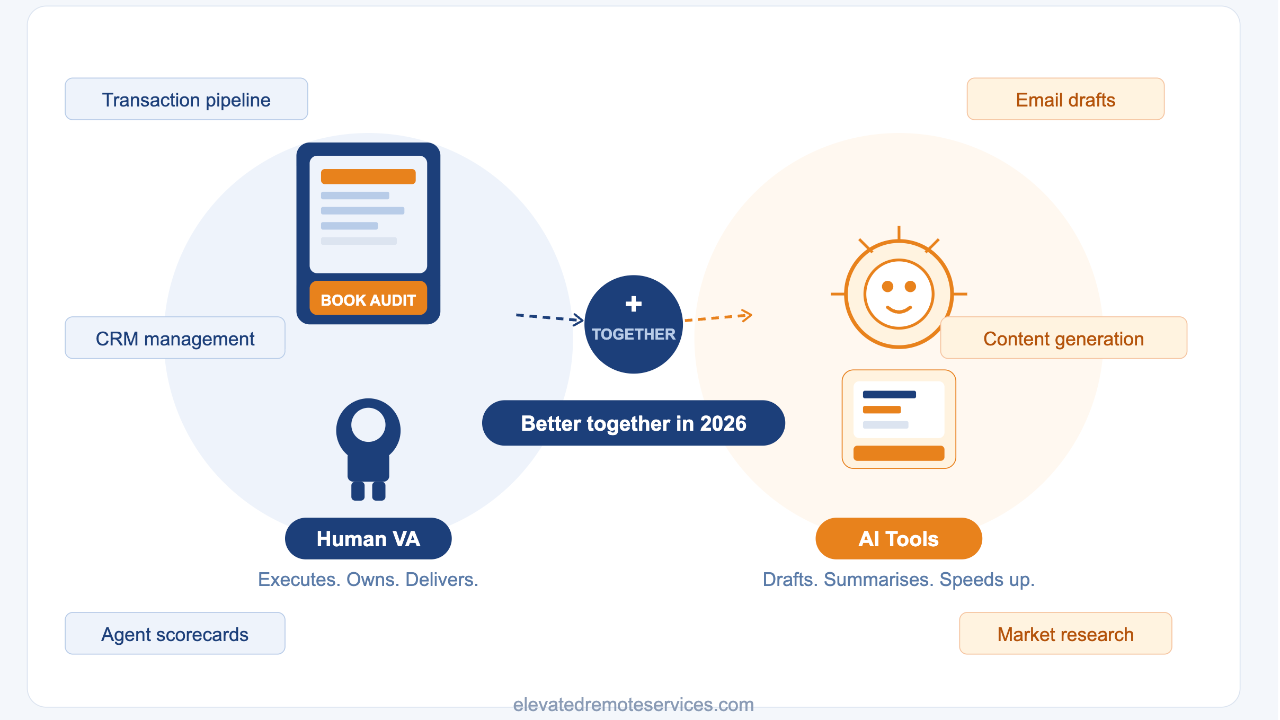
Published by Elevated Remote Services | elevatedremoteservices.com
It is a fair question. ChatGPT can write emails, Gemini can summarise documents, and AI tools can now draft contracts, generate market reports, and respond to leads in seconds. So why would a real estate team in 2026 pay for a virtual assistant when artificial intelligence can do so much for free?
The answer is not that AI is overhyped. It is genuinely powerful and getting better every month. The answer is that running a real estate team is not primarily an information problem — it is an execution problem. And execution, at the level real estate teams actually need it, still requires a human.
Here is the honest breakdown.
What AI Does Very Well for Real Estate Teams
Let's give AI its full credit first.
Drafting and writing. AI tools are excellent at generating first drafts of emails, follow-up sequences, listing descriptions, social media captions, and blog content. A task that took 30 minutes now takes 3. This is real and valuable.
Summarising and analysing information. Upload a contract, a market report, or a set of agent call logs and AI can extract key points, identify patterns, and surface insights faster than any human reader.
Answering common questions. AI-powered chatbots can handle inbound lead inquiries, answer FAQs about listings, and qualify prospects around the clock — without anyone on your team lifting a finger.
Generating templates and checklists. Need a transaction checklist, an onboarding guide, or a communication template? AI can produce a solid first version in seconds.
Research. Competitive analysis, neighbourhood data, comparable sales summaries — AI can pull and synthesise information at a speed no human researcher can match.
If your team is not using AI tools for these functions in 2026, you are leaving efficiency on the table. The best real estate teams use AI heavily for these tasks.
What AI Cannot Do for Real Estate Teams
Here is where the conversation gets more honest than most AI-era articles are willing to be.
AI cannot execute tasks inside your systems. Writing a follow-up email is not the same as logging into your CRM, finding the right contact, updating the lead stage, attaching the note, and scheduling the next task. AI generates content. A human VA executes the workflow. These are fundamentally different functions — and the second one is where your operation actually runs.
AI cannot manage your transaction pipeline. Tracking 47 active transactions across different stages, chasing missing documents, sending milestone reminders to lenders, attorneys, and clients, and flagging at-risk deals before they fall apart — none of this happens automatically. AI can help you draft a reminder email. It cannot monitor your pipeline every morning, identify which transactions need attention today, and take action before you even know there is a problem.
AI cannot be accountable. When a deadline is missed, a document goes unsigned, or a client falls through the cracks — AI has no accountability. It cannot follow up, course-correct, or take ownership of an outcome. A trained, dedicated VA can. The difference between a tool that assists you and a person who is responsible is enormous.
AI cannot build relationships. Real estate is a relationship business. The human on the other end of a client email, the person who remembers that a particular agent is struggling with conversion rates, the VA who has worked with your team for three years and understands your preferences without being told — none of that is replicable by AI in any meaningful way.
AI cannot handle the unexpected. Real estate transactions are full of surprises. A lender requests a document that was not on the original checklist. A client calls with a concern outside of office hours. A title issue surfaces two days before closing. AI cannot improvise, escalate appropriately, or exercise judgment in novel situations. A human VA can.
AI cannot manage itself. AI tools require prompts. Someone on your team has to write the right prompt, check the output, correct the errors, and apply the result to the right place. That someone is usually your ops manager, your TC, or you. Every hour spent managing AI tools is an hour not spent on revenue-generating activity. A VA manages their own work.
The Real Estate Tasks Where Human VAs Are Irreplaceable in 2026
Transaction Coordination
MLS listing setup, document collection, deadline tracking, compliance oversight, lender communication, title coordination, and post-closing file management — this is a sequence of interdependent, time-sensitive actions that require judgment, follow-through, and accountability at every step.
AI can draft the checklist. A VA runs the checklist, flags exceptions, and ensures nothing falls through the cracks on 40 simultaneous transactions.
The Dave Friedman Team in Charleston, South Carolina found that with ERS virtual assistant support, each of their transaction coordinators could handle 10 additional deals per month — not because AI was doing the coordination, but because human VAs were absorbing the administrative load that freed TCs to focus on the higher-judgment work.
Agent Performance Tracking and Scorecards
High-performance real estate teams run on data. Agent call volumes, appointment conversions, pipeline velocity, and goal-versus-actual tracking — these numbers need to be collected, consolidated, calculated, and delivered to leadership every single day.
Can AI generate a scorecard template? Absolutely. Can AI log into your MOJO dialer, your CRM, your call tracking software, and your MLS platform, pull the right data, cross-reference it, calculate the correct metrics, and deliver a formatted report to your ops manager's inbox at 7am every morning? No.
High Performance Real Estate Advisors in Charlotte, NC found that before ERS, their leadership team was running scorecards themselves — and the reports were rushed, inaccurate, and often late. With ERS handling the daily tracking, scorecards are delivered at 100% accuracy every morning, independently of leadership's availability.
As Thomas Elrod, owner of HPREA, put it: "I am a big believer that you have to inspect what you expect… Vishnu and her team always come back 100% correct."
AI did not replace that. A dedicated, accountable human VA team made it possible.
Commission Processing and Document Verification
Commission payment processing, document verification, and compliance filing — these tasks involve accessing multiple platforms, cross-referencing data, identifying errors, and maintaining accurate records across a complex chain of transactions.
AI can flag anomalies in data it has been given. A VA logs into the systems, pulls the actual documents, verifies the numbers against the contract, processes the payment, and files the record correctly.
Ella Thigpen, Director of Operations at the Dave Friedman Team, noted that with ERS handling these functions: "The team has also created workflows that we still use for agents and operational staff to be more effective. Our listing coordinator can handle twice as many deals, and our transaction coordinators can handle an additional 10 deals a month."
CRM Management and Lead Tracking
Daily lead uploads from Zillow, Realtor.com, and other portals. Updating contact records after agent interactions. Moving leads through pipeline stages. Scheduling follow-up tasks. Merging duplicates and cleaning data. Tagging leads with the right source and status.
This is not glamorous work. It is also not work AI can do autonomously inside your CRM. It requires someone with system access, attention to detail, and the judgment to know what matters.
Ella Thigpen described ERS VAs as having "worked with every CRM out there" and understanding real estate "at a high level." That depth of operational knowledge is not something you prompt into existence.
FSBO and Expired Lead List Preparation
Every morning, top-producing teams have agents starting their prospecting calls with a fresh, accurate list of FSBO and expired listings — sorted, formatted, and ready to dial.
Who builds that list? Not AI. A trained VA who knows your market, understands your prospecting criteria, and delivers the list independently every single morning so that agents can start calling the moment their shift begins.
The Right Model for 2026: AI Plus Human VAs
The most effective real estate teams in 2026 are not choosing between AI and virtual assistants. They are using both — for different things.
| Function | Best Handled By |
|---|---|
| Drafting emails and communications | AI (with human review) |
| MLS Listing Management & Listing Activation | Human VA |
| Summarising market data | AI |
| Contract-to-Close Management | Human VA |
| Generating listing descriptions | AI (with human edit) |
| Agent Performance Reports & Scorecards | Human VA |
| Answering basic lead inquiries | AI chatbot |
| Commission Disbursement Authorization (CDA) | Human VA |
| Creating templates and checklists | AI |
| Buyer Pipeline Reports & FSBO list preparation | Human VA |
| Research and data analysis | AI |
| Compliance Review & Submission | Human VA |
| CMA & Equity Analysis data compilation | AI (with VA execution) |
| CRM Updates & Database Management | Human VA |
AI handles the generation. Human VAs handle the execution. Together they produce more than either could independently.
The team leaders who try to replace execution with AI end up with beautifully written emails that nobody sends, perfectly generated checklists that nobody runs, and scorecard templates that never get filled in. The operations still require a human hand.
Why This Matters More, Not Less, in the AI Era
Here is the counterintuitive reality: as AI tools proliferate, the human elements of a real estate operation become more valuable, not less.
When every team is using AI to draft the same emails and generate the same content, differentiation comes from execution. The team that follows up faster, tracks transactions more accurately, runs agents more accountably, and delivers a more consistent client experience will win — not because their AI is better, but because their operations are tighter.
That operational tightness comes from dedicated, trained, accountable human VAs who own their piece of the workflow.
What to Look for in a VA in the AI Era
If you are hiring a VA in 2026, the right person is not someone who does what AI can do. It is someone who does what AI cannot.
Look for:
- Execution capability — can they actually complete multi-step workflows inside your systems, not just advise on them
- Accountability — do they own outcomes, not just tasks
- Real estate knowledge — do they understand the language, the urgency, and the stakes of a transaction environment
- Judgment — can they identify when something is wrong and escalate appropriately without being prompted
- Reliability — do they show up, every day, at the quality level you need
These are human qualities. They are not prompts.
How ERS Approaches the AI Era
At Elevated Remote Services, we equip our virtual assistants with AI tools where they genuinely add speed — drafting templates, researching data, summarising information. But we are clear-eyed about what AI does and does not replace.
Our VAs handle the execution layer of real estate operations across four service areas — Listing Coordination, Transaction Coordination, CRM & Operations Support, and Scorecards & Reports — because those functions require a human who is accountable, knowledgeable, and reliable.
The teams we serve are not choosing between AI and ERS. They are using AI for what it is good at and ERS for what it is not. That combination is what lets a listing coordinator handle twice as many deals, a TC manage 10 more transactions per month, and an ops director run an entire additional side of the business.
If you want to see how that works in practice for your team, start with a free 20-minute operations audit. We will map your current workflow, identify where AI is already helping and where human execution is still the bottleneck, and recommend a plan that fits.
No commitment. No contract.
👉 Book your free operations audit
Frequently Asked Questions
Can AI replace a real estate virtual assistant? Not in 2026 — and not for the foreseeable future. AI excels at generating content, summarising information, and answering predictable questions. It cannot execute multi-step workflows inside real estate systems, manage transaction pipelines, process commissions, track agent performance, or build the accountable human relationships that real estate operations depend on. The best teams use both.
Is it worth hiring a VA when AI tools are free? Yes — because AI tools and VAs solve different problems. AI reduces the time it takes to create content and analyse information. A VA reduces the time it takes to execute operational workflows. Both save time, but in fundamentally different parts of your business.
What tasks should I use AI for vs a VA? Use AI for drafting, summarising, researching, and generating templates. Use a VA for executing CRM workflows, managing transactions, tracking agent performance, processing documents, and preparing daily lead lists. The two are complementary, not competing.
How do ERS VAs use AI in their work? ERS VAs use AI tools to work faster on appropriate tasks — drafting communications, researching data, generating initial content. But their core function — execution inside your systems, accountability for outcomes, and daily operational reliability — remains human. AI is a tool in their workflow, not a replacement for it.
Will AI get good enough to replace VAs eventually? Possibly, for some narrow and well-defined tasks. But real estate operations involve judgment, relationships, cross-system execution, and accountability in ways that make full AI replacement a distant prospect. In the near term, the teams that win will be those who combine AI efficiency with human operational excellence — not those who try to replace one with the other.
Elevated Remote Services has been supporting real estate teams across the United States since 2016. Trusted by 50+ teams nationwide including Keller Williams, eXp Realty, and Real Estate B-School.
Ready to see how ERS and AI work together for your team? Book a free 20-minute operations audit →