
How to Onboard a Real Estate Virtual Assistant: A Step-by-Step Guide (2026)
Jun 09, 2026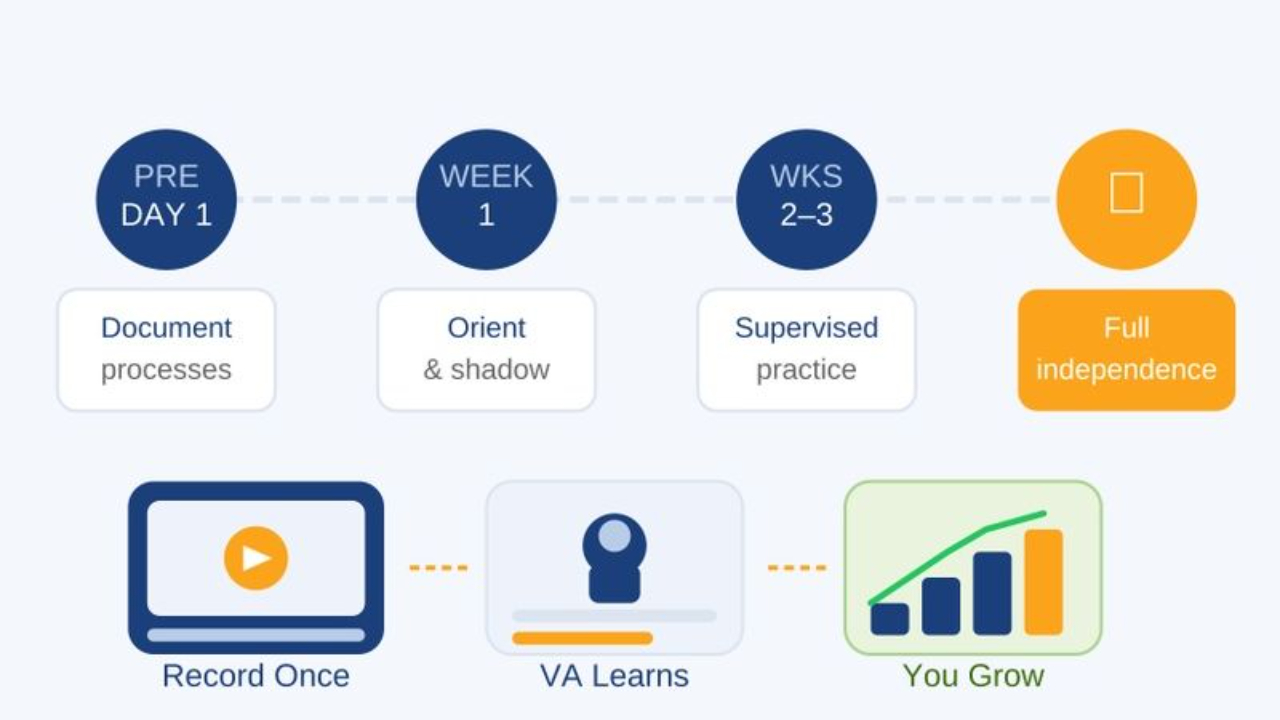
Published by Elevated Remote Services | elevatedremoteservices.com
Hiring a real estate virtual assistant is the easy part. Onboarding them effectively is where most teams either unlock significant value or waste weeks going in circles.
A well-onboarded VA becomes independently productive within 4–6 weeks and continues improving for months. A poorly onboarded VA requires constant correction, produces inconsistent output, and often leads teams to conclude that VAs "don't work" — when the real problem was the onboarding process.
This guide covers exactly how to onboard a real estate VA, step by step, from day one to full independence.
Why Onboarding Matters More Than Hiring
Most team leaders spend the most time on hiring — reviewing profiles, interviewing candidates, checking references. Then they send the new VA a list of tasks and hope for the best.
The result is predictable: unclear expectations, inconsistent output, and frustration on both sides.
The teams that get the most from their VAs invest the first 4–6 weeks in a structured onboarding process. The payoff is a VA who operates with minimal oversight, owns their deliverables, and produces reliable output day after day — without needing constant management from you.
High Performance Real Estate Advisors in Charlotte, NC went from rushed, inaccurate scorecards to 100% accuracy delivered every morning — not because they hired a better person, but because ERS's structured onboarding built the right foundation before the VA ever started working independently.
Before Day One: Preparation Checklist
The most common onboarding failure is starting before you're ready. Here is what to prepare before your VA's first day:
Document your current processes Every task your VA will handle needs a written process or a screen-recording walkthrough. If you can't explain how to do it, you can't delegate it. This documentation step is the single most valuable thing you can do before onboarding begins.
List every tool they'll need access to CRM (Follow Up Boss, KVCore, Salesforce, etc.), MLS, transaction management platform (Dotloop, Skyslope), Google Workspace, communication tools (Slack, Zoom), any prospecting tools (MOJO, Vulcan7). Compile the full list and prepare login credentials or invite links.
Define their primary tasks and priorities What are the 3–5 tasks you most need this VA to own? Be specific. "Transaction coordination" is not specific. "Entering new listings into MLS within 2 hours of receiving the listing agreement, updating the Dotloop checklist, and sending a milestone email to the client" is specific.
Set your communication expectations How will you communicate daily? Slack? Email? WhatsApp? When does the VA's shift start and end? How should they flag urgent issues? Decide this before day one — not on day one.
Prepare a welcome document A single document covering: who you are, what your team does, your key clients and current pipeline, the tools you use, your communication preferences, and what success looks like in the first 30/60/90 days. This gives your VA context they cannot get from task instructions alone.
Week 1: Orientation and Observation
The goal of week 1 is not output. It is understanding.
Day 1–2: Introduction and context Walk the VA through your business — your team structure, your clients, your current transaction pipeline, and your operational rhythms. Let them observe how you and your team work before asking them to do anything independently.
Day 3–4: Tool access and walkthrough Give the VA access to every tool they will use. Walk through each one via screen share. Show them — don't just tell them. Record these walkthroughs so they can refer back to them.
Day 5: Shadow mode Have the VA watch you or your ops manager complete one full cycle of each primary task. They take notes. They ask questions. They do not do anything independently yet.
End of week 1 checkpoint: Ask the VA to summarise what they have learned and how they understand each task. This surfaces misunderstandings early — before they affect real work.
Week 2: Supervised Practice
The goal of week 2 is building muscle memory under supervision.
Supervised task completion The VA completes tasks while you or a team lead can review the output before it goes live. For transaction tasks — before emails are sent to clients, before MLS updates go live, before reports are distributed.
Immediate feedback Correct errors in real time, not in a weekly review. The faster feedback loops are in week 2, the faster the VA reaches independence.
Process refinement As the VA completes tasks, gaps in your documentation will surface. Update your process documents as you go. This benefits every future team member, not just the current VA.
End of week 2 checkpoint: Review output quality on each task type. Where is the VA confident and accurate? Where does more practice or clarification need to happen?
Weeks 3–4: Independent Work with Check-ins
The goal of weeks 3–4 is building confidence and catching edge cases.
Daily check-ins (15 minutes) A short daily standup — what did you complete yesterday, what are you working on today, any blockers? This maintains visibility without micromanagement.
Reduce the review layer Tasks where the VA has demonstrated accuracy move out of pre-approval. Low-risk tasks (data entry, report preparation, list building) become fully independent. Higher-stakes tasks (client-facing communication, compliance documents) remain on a review layer a little longer.
Introduce edge cases Real estate operations are full of situations that don't follow the standard process. Walk the VA through common exceptions — what to do when a document is missing, how to handle a deadline extension request, when to escalate vs. when to resolve independently. This is where good VAs separate themselves from average ones.
End of week 4 checkpoint: A formal review covering task accuracy, communication quality, proactivity, and any unresolved questions. This is the point at which most VAs are ready for full independent operation on their primary tasks.
Weeks 5–6: Full Independence
The goal of weeks 5–6 is transition to fully independent operation.
Move to weekly check-ins Replace daily standups with a weekly review. Output quality should be consistent enough that daily oversight is no longer necessary.
Assign ownership, not just tasks The best VAs don't just complete tasks — they own outcomes. Transition language from "please do X" to "you own X — let me know if anything needs my input." This mental shift matters. It tells the VA that they are responsible for the outcome, not just the action.
Document what you've built By the end of week 6, your process documentation, tool access, and communication rhythms should all be fully established. This documentation is now a company asset — it makes every future team member faster to onboard.
End of week 6 checkpoint: The VA should be completing all primary tasks independently, flagging exceptions proactively, and delivering consistent output without prompting. If this is not the case, identify the specific gap and address it directly rather than extending general supervision.
The Most Common Onboarding Mistakes
Starting without documented processes If you can not explain the task clearly in writing, you are not ready to delegate it. Skipping documentation creates ambiguity that compounds over time.
Expecting too much too soon Teams that expect full productivity in week 1 set their VA up to fail. The 4–6 week ramp-up is not a sign of a slow VA — it is the cost of building a reliable operation.
Giving feedback too infrequently Weekly feedback in the first two weeks is not enough. Daily or same-day correction in weeks 1–2 dramatically accelerates the learning curve.
Not defining what "good" looks like "Please send the daily report" is incomplete. "Please send the daily report by 8am EST, covering these 5 metrics, formatted like this template, to these three recipients" is a complete instruction. Vague instructions produce vague output.
Overloading the VA in week 1 Giving a new VA 15 different tasks in week 1 guarantees mediocre performance on all of them. Start with 2–3 core tasks, master them, then expand scope.
Skipping the welcome document Context matters. A VA who understands your business, your clients, and your goals makes better decisions than one who only knows their task list.
How ERS Handles Onboarding
ERS's structured onboarding process takes 4–6 weeks from signup to fully independent operation. Here is how it works:
Week 1–2: You record, we learn You record screen-share walkthroughs of your key processes using any screen recording tool. ERS learns from those recordings, studies your systems, and asks clarifying questions. You do not run live training sessions — your time investment is recording once, not teaching repeatedly.
Weeks 3–4: Supervised practice ERS VAs complete tasks under supervision of a senior team lead. Output is reviewed before going live. Errors are corrected internally before they reach your team.
Weeks 5–6: Go-live The VA transitions to independent operation. A delivery manager maintains quality oversight on the ERS side — you do not manage the VA's performance directly.
After onboarding: You own the outcomes. ERS owns the management. Your weekly touchpoint is a brief check-in with your ERS delivery manager, not daily supervision of individual tasks.
This model is why HPREA described their ERS team as operating at "100% correct" accuracy — and why Ella Thigpen at the Dave Friedman Team noted that ERS "delivers on time" and that "if there's ever a concern, they ask, and we're able to fix it ASAP."
Onboarding Timeline Summary
| Timeframe | Focus | Goal |
|---|---|---|
| Before day 1 | Prepare documentation, tools, welcome doc | Ready to start |
| Week 1 | Orientation, tool access, shadowing | Understanding |
| Week 2 | Supervised practice, immediate feedback | Accuracy |
| Weeks 3–4 | Independent work, daily check-ins | Confidence |
| Weeks 5–6 | Full independence, weekly reviews | Ownership |
| Ongoing | Weekly check-ins, scope expansion | Growth |
Frequently Asked Questions
How long does it take to onboard a real estate virtual assistant? A well-structured onboarding takes 4–6 weeks to reach full independent operation. Rushing this timeline typically results in lower quality output and more management overhead later.
Do I need to train my VA on every tool? Yes — any tool your VA will use needs a walkthrough. Screen-recorded walkthroughs are the most efficient method. Record once, the VA refers back as needed.
What if my VA makes mistakes during onboarding? Mistakes during onboarding are expected and normal. The goal is to catch them quickly, correct them immediately, and use them to refine your process documentation. Mistakes caught in week 2 are far better than mistakes discovered in month 3.
How many tasks should I give a new VA? Start with 2–3 core tasks in week 1. Add tasks progressively as each one reaches consistent accuracy. Overloading in week 1 is the most common onboarding mistake.
What is the difference between a task and an ownership area? A task is something you ask someone to do. An ownership area is something someone is responsible for, whether you ask or not. The goal of good onboarding is to transition from tasks to ownership — a VA who proactively manages their area without waiting to be directed.
How do I know when my VA is fully onboarded? When they complete all primary tasks independently, flag exceptions proactively without prompting, and deliver consistent output without daily check-ins required from you.
Elevated Remote Services has been supporting real estate teams across the United States since 2016. Trusted by 50+ teams nationwide. ERS's managed onboarding process handles the training, supervision, and quality oversight — so you don't have to.